Changing My Mind ...
The Dead Sea Scrolls

[Note: If you just want an “X” (formerly twitter) style post, check out “The Summary” at the end of this post.]
“The Scrolls are not in fact one book, but a miscellaneous collection of writings retrieved from caves near Qumran, at the northwest corner of the Dead Sea, between the years 1947 and 1956. In all, fragments of some nine hundred manuscripts were found. They are written mostly in Hebrew, with some in Aramaic and a small number in Greek. They date from the last two centuries BCE and the first century CE.”[1]
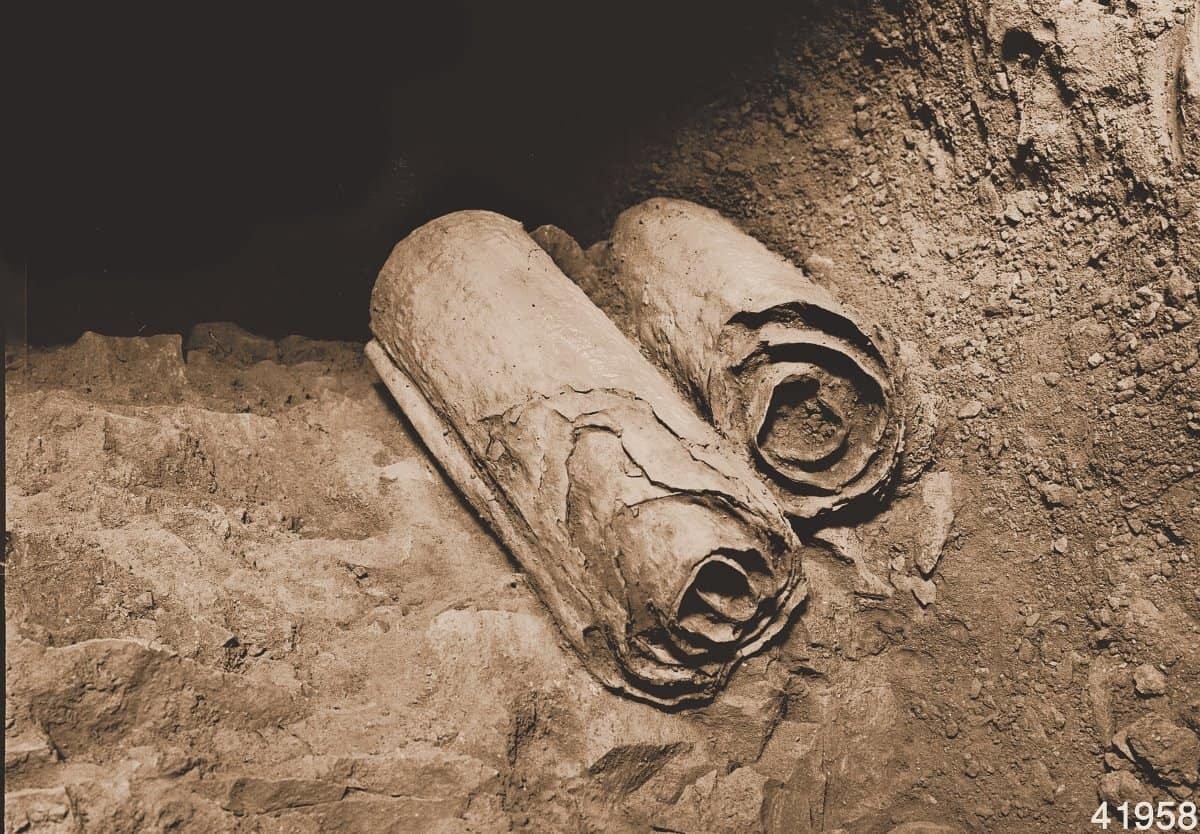
Manuscript pieces, some as small as a postage stamp, by the thousands were discovered in a series of caves, from 1947 to 1956. Collectively, referred to as “The Dead Sea Scrolls,” they represent over 900 separate manuscripts, a quarter of which are diverse copies of books which would later be included in the Jewish Bible. Research began almost immediately and continues to this day. Until the early 1990s very few results of the research were made public, not just to the general public, but even to the rest of academia. Numerous books have recorded, more or less accurately, on this greatest literary discovery of the twentieth century.[2]
In addition to being a window shedding light on the world of the Second Temple period—where before there had been very little light—they also have provided us with manuscripts of Hebrew Bible texts that are more than 1000 years earlier than any previously known Hebrew manuscripts of these books! As a result, there are “[t]wo subjects about which the Dead Sea Scrolls give us important new data … the history of the transmission of the text of the Hebrew Bible (the Christian Old Testament) and the ways in which that text was interpreted.”[3] Learning about these two subjects, as revealed by the DSS, hugely impacted and accelerated changing my mind regarding my conservative Christian theological and biblical dogma.
I’ve read numerous volumes, mostly written by actual DSS scholars, which provide undeniable data in support of what Eugene Ulrich calls, “the developmental composition of the Bible,”[4] and what Shemaryahu Talmon calls, “the progressive evolution of what was to become the ‘Hebrew Bible canon’; in other words, a clarification of the question ‘How did the Bible grow?’.”[5]
What I heard from, and was taught, by my conservative Christian leaders, teachers, and mentors was that the DSS confirmed all that we knew about the history and formation of the Bibles we now possess. This discovery was presented as amazing proof of everything we believed about the Bible, proving that it must be the inspired word of God.
Andrew Perrin summarizes that the DSS not only confirm some things we already knew or believed, but that they also challenge and/or change many things we thought that we knew and that we claimed to believe about the formation of the biblical texts. I lived many years with the understanding that these much older biblical manuscripts found among the DSS are essentially identical to the previously oldest biblical manuscripts we possessed. This was presented as proof that God oversaw and essentially preserved the Hebrew text from which Jews translated their Tanakh and that Christians translated the Old Testament.
Another idiom used, among my conservative Christian leaders, teachers, and mentors, to describe the time between the end of the Old Testament (Malachi) and the beginning of the New Testament (Matthew) was “the Four Hundred Silent Years.” In other words, during this period of time I was taught and believed that not only was there nothing of significance written, but God’s chosen people were silent regarding vital spiritual issues.
However, nothing could be further from reality. As Perrin notes, what may be a solitary and very thin blank page between the writings of the two testaments in our Christian Bibles is a period of extensive literary creation which included …
… tales of empires toppling, cultures clashing and generations caught in the timeless tug of war between staying faithful to the past while living in the present. This is the world of the DSS. The age is often referred to as Second Temple Judaism with the mid– to late–Second Temple period being most relevant to the DSS (third century BCE to 70 CE).[6]
These texts—written and/or copied and stored in the Judean desert—reveal innovative and transformative shifts of thought, culture, belief and practice that were “formative to biblical literature and foundational for emerging Judaism and Christianity.” These was far from the “silent years” that I was led to believe by my conservative Christian teachers.
However, to give credit to my conservative Christian leaders, teachers, and mentors, my early education regarding the DSS occurred before access to all of the scrolls and research. Yet, even after DSS and research was made public, little has changed in the conservative Christian message: the DSS confirm that the Masoretic Text (MT) of ca. 900–1000 CE, has been almost “miraculously” preserved. Very little recognition is given, or emphasized, that the MT family of DSS texts was just one of numerous families of texts that existed during the Second Temple period. Also ignored by conservatives is the fact that the earliest Christians’ “Bible” (i.e., individual scrolls) predominantly consisted of the Greek translations of various Hebrew texts.
Make no mistake about it, the discovery of the scroll remnants in the Judaean desert instigated a crisis where a new paradigm of textual pluriformity challenged and changed the old paradigm of textual consistency and uniformity. Timothy Michael Law states, “The discoveries in the Judean Desert in the middle of the twentieth century revolutionized our understanding of the Bible’s history or, better, its prehistory.”[7] With the discovery of the DSS, there was clear and incontrovertible evidence that the state of the prebiblical texts was one of pluriformity and an absence of any text-type hierarchy.[8]
Just as the sun was once thought to revolve around the planet earth, so the biblical texts were thought to have reached their final and unified state in the mid-Second Temple period, and thus were faithfully preserved and accurately represented by the early eleventh-century CE Leningrad Codex.[9] Just as Copernicus (and other men of science) revealed a different reality, so the discovery of the DSS has revealed a different and much more complex and messy history of the biblical texts at every stage of textual creation—i.e., origin, transmission, redaction, and translation.[10]
What I didn’t know that I didn’t know, for far too long, was that the DSS discovery and research provides us with incontrovertible evidence of the pluriform state of the prebiblical texts. It became clear to me that there is not now, and never has been, one collection of authoritative texts that have been almost miraculously preserved throughout the centuries. The history of “how we got the Bible” is indeed extremely complex and messy. In my next post, I will discuss what I didn’t know that I didn’t know about the effect of biblical pluriformity had on the science of textual criticism.
The Summary
What I Knew: The discovery of the DSS was truly amazing; the majority of biblical manuscripts proved the reliability of textual transmission over a period of 1000–1200 years; this was only possible if God oversaw the transmission process.
What I Didn’t Know that I Didn’t Know: Rather than uniformity, the DSS demonstrate clearly the pluriformity of the biblical texts during the Second Temple period and that the further one goes back in the history of the biblical texts, the messier and more complex is the textual evidence.
[1] John J. Collins, The Dead Sea Scrolls: A Biography (Princeton: Princeton University Press, 2013), Preface (Kindle Edition).
[2] In addition to the J. J. Collins book (above) see also: Timothy Lim, The Dead Sea Scrolls: A Very Short Introduction (Oxford: Oxford University Press, 2017); Andrew B. Perrin, Lost Words and Forgotten Worlds: Rediscovering the Dead Sea Scrolls (Bellingham, WA: Lexham Academic, 2025).
[3] Sidnie White Crawford, Rewriting Scripture in Second Temple Times (Grand Rapids, MI: Wm. B. Eerdmans Publishing Company, 2008), Preface. Kindle Edition.
[4] Eugene Ulrich, The Dead Sea Scrolls and the Developmental Composition of the Bible (Leiden: Brill, 2015).
[5] As quoted by Ulrich in his above referenced monograph.
[6] Perrin, Lost Words and Forgotten Worlds, xxii.
[7] Timothy Michael Law, When God Spoke Greek: The Septuagint and the Making of the Christian Bible (Oxford: Oxford University Press, 2013), 2, 21. See also, Hans Debel, “Rewritten Bible, Variant Literary Editions and Original Text(s): Exploring the Implications of Pluriform Outlook on the Scriptural Tradition,” in Changes in Scripture: Rewriting and Interpreting Authoritative Traditions in the Second Temple Period, Hanne van Weissenberg, Juha Pakkala and Mark Marttila, eds., (Berlin: De Gruyter, 2011), 65; Allen, “Textual Pluriformity,” 103; Eugene Ulrich, “Our Sharper Focus on the Bible and Theology Thanks to the Dead Sea Scrolls,” in The Catholic Biblical Quarterly, Jan. 2004, 2.
[8] Garrick V. Allen, “Textual Pluriformity in Jewish and Christian Antiquity,” in The Book of Revelation and Early Jewish Textual Culture, 39–104. Society for New Testament Studies Monograph Series (Cambridge: Cambridge University Press, 2017), 45, n. 19; James Nati, Textual Criticism and the Ontology of Literature in Early Judaism: Ana Analysis of the Serekh Ha-Yahad, Supplements to the Journal for the Study of Judaism, Vol. 198 (Leiden: Brill, 2021), 3; Brennan W. Breed, Nomadic Text: a Theory of Biblical Reception History (Bloomington, IN: Indiana University Press, 2014), 22.
[9] Eugene Ulrich, “The Evolutionary Production and Transmission of the Scriptural Books,” in Changes in Scripture: Rewriting and Interpreting Authoritative Traditions in the Second Temple Period, edited by Hanne von Weissenberg, Juha Pakkala and Marko Marttila (Berlin: DeGruyter, 2011), 47: “Before the Dead Sea Scrolls…the prevailing view was that the composition of many biblical books was complete…and that those completed forms constituted “the original text…”. Also, Allen, “Textual Pluriformity,” 43: “Non-MT text families were regarded as secondary, sectarian, or…poor translations. The MT was the ‘inspired’ or ‘original’ text and was the textual witness that most closely reflected the possible Urtext in the mind of most scholars. This perspective continues to hold sway in some sectors of popular perceptions. However, the find of Qumran have forced a complete reconsideration of the textual evidence.”
[10] For detailed examples of the incontrovertible and persistent textual pluriformity of biblical texts, I highly recommend Eugene Ulrich, The Dead Sea Scrolls and the Origins of the Bible, Studies in the Dead Sea Scrolls and Related Literature (Grand Rapids, MI: Eerdmans Publishing, 1999) and/or Eugene Ulrich, The Dead Sea Scrolls and the Developmental Composition of the Bible, Supplements to Vetus Testamentum: the Text of the Bible at Qumran (Leiden: Brill, 2015).
Really interesting and beautifully written.